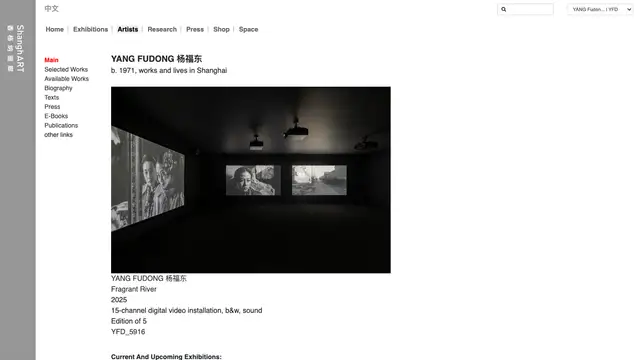
 Художник
Yang Fudong
Yang Fudong — источник профилей художников с проверенной главной страницей, расположенный в Китай, с фокусом на Современное искусство.
artistsprofilesresearch
Подходит дляПоиск художников / Исследование портфолио
Переходите к художникам, галереям, магазинам, выставкам и исследовательским источникам по теме Film.
ХудожникYang Fudong — источник профилей художников с проверенной главной страницей, расположенный в Китай, с фокусом на Современное искусство.
Wang Tuo was born in Changchun in 1984 and lives and works in Beijing. His practice includes film, painting and drawing. Research into Chinese modern history, cultural archives, fiction and mythology is reorganized through scripts and moving images that test how historical narratives are constructed. Two gallery archives provide complementary public documentation; the page treats them as representation sources and does not describe either as an official artist website. This profile prioritizes verifiable project context and direct source links so readers can continue into the artist's work, exhibitions and published record. It is an editorial introduction, not a ranking or a substitute for the cited source material.
Tyler Mitchell makes photographs and films that explore the possibilities of Black leisure, self-presentation and imagined freedom. Based in Brooklyn, he works across commissioned fashion imagery and projects developed for exhibitions and books. His early photobook El Paquete, published in 2015, followed architecture and skateboard culture in Havana. Later work brings portraiture, outdoor settings and the language of fashion into dialogue with questions about who gets to inhabit an idyllic scene. His artist website allows these strands to be considered together rather than reducing the practice to a prominent magazine cover. For a first reading, compare the placement of a figure in a landscape with the construction of a commissioned portrait. The settings, gestures and relationships between people can carry as much meaning as the individual face.
Titus Kaphar reworks the conventions of representational painting through physical interventions in its surfaces and supports. Cutting, covering, crumpling and removing parts of an image become ways to question whose presence is emphasized and whose history is obscured. His practice includes sculpture and film as well as painting, with the history of representation remaining a central concern. The studio archive groups works by processes such as cutouts, whitewash and wrapped paintings, giving readers a practical route into the relationship between technique and meaning. His gallery documentation situates the work in the New Haven studio and provides exhibition context. Compare the altered surface of a painting with what remains visible underneath or around it: the intervention changes not only the picture but also the viewer's position in relation to its subject.