Identifica la fuente
Los sitios oficiales, instituciones, galerías, mercados, tiendas y medios editoriales cumplen funciones distintas.
Explora recursos de arte revisados desde el tema Foco profundo en China.
Esta guía aclara los tipos de fuentes, las rutas de exploración y los límites de verificación de Foco profundo en China antes de entrar al directorio.
Los sitios oficiales, instituciones, galerías, mercados, tiendas y medios editoriales cumplen funciones distintas.
Confirma fechas, autoría, obras, precios, horarios y condiciones en el sitio enlazado.
Lee cada recurso junto a su lugar, medio, institución y creador, sin sustituir el criterio por popularidad o rankings.
Etsy Art es una fuente de tiendas de arte con página de inicio verificada, ubicada en Global / Online, con foco en Artesanía, Grabados, Cerámica.
ArtistaAi Weiwei es una fuente de perfiles de artistas con página de inicio verificada, ubicada en China, con foco en Arte contemporáneo.
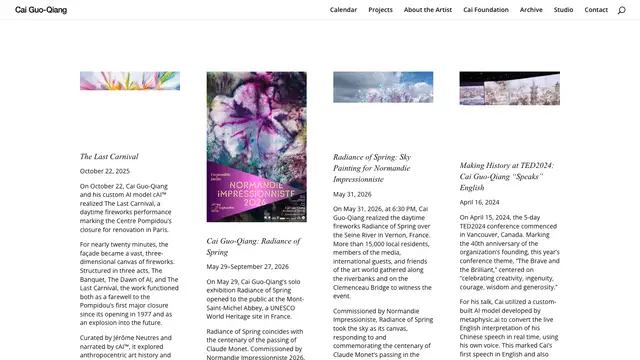
ArtistaCai Guo-Qiang es una fuente de perfiles de artistas con página de inicio verificada, ubicada en China, con foco en Arte contemporáneo.
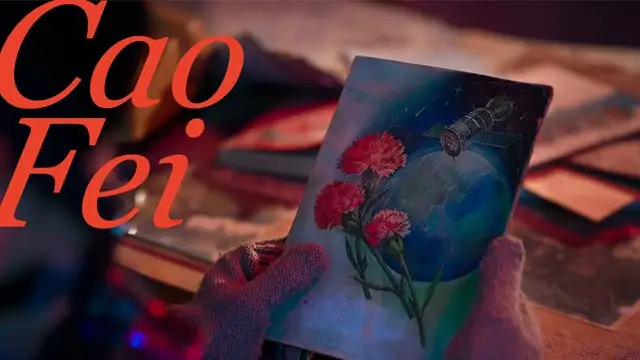
ArtistaCao Fei es una fuente de perfiles de artistas con página de inicio verificada, ubicada en China, con foco en Arte contemporáneo.
ArtistaXu Bing es una fuente de perfiles de artistas con página de inicio verificada, ubicada en China, con foco en Arte contemporáneo.
Bu Hua es una fuente de perfiles de artistas con página de inicio verificada, ubicada en China, con foco en Arte contemporáneo.
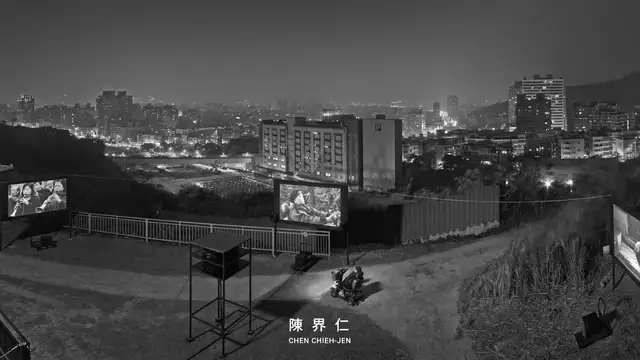
ArtistaChen Chieh-Jen es una fuente de perfiles de artistas con página de inicio verificada, ubicada en China, con foco en Arte contemporáneo.
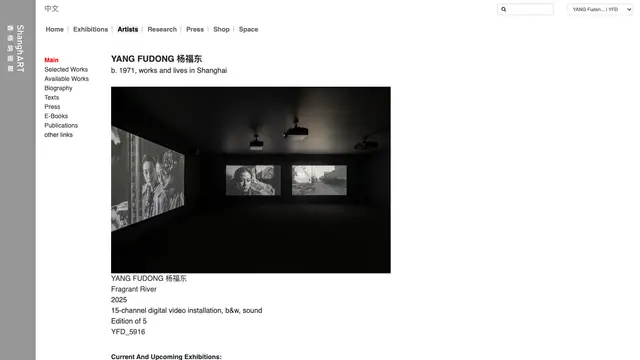
ArtistaYang Fudong es una fuente de perfiles de artistas con página de inicio verificada, ubicada en China, con foco en Arte contemporáneo.
Yinka Shonibare es una fuente de perfiles de artistas con página de inicio verificada, ubicada en Reino Unido, con foco en Arte contemporáneo.
ArtistaZheng Lu es una fuente de perfiles de artistas con página de inicio verificada, ubicada en China, con foco en Arte contemporáneo.
Zhang Huan's primary artist page documents works, projects and exhibition context across sculpture, painting.
Levana Finkelstein's primary artist page documents works, projects and exhibition context across sculpture.
Tinkebell's primary artist page documents works, projects and exhibition context across sculpture, contemporary art.
Ye Feng (also listed as Feng Ye) is a Ningbo-based Chinese sculptor and MRSS member whose monumental practice connects sculpture, architecture and the public realm through civic, cultural and urban projects.
She is a Nigerian-born artist based in Los Angeles. Her layered compositions combine painting, drawing and photographic image transfer. Domestic interiors and family images connect personal memory with migration and cultural hybridity. The official site is especially useful for reading bodies of work together rather than encountering isolated auction or editorial images. This profile prioritizes verifiable project context and direct source links so readers can continue into the artist's work, exhibitions and published record. It is an editorial introduction, not a ranking or a substitute for the cited source material.
Lee Bul is a Korean artist whose practice spans sculpture and immersive installation. Her work has repeatedly examined the body, technology, utopian architecture and failed modernist ideals. The artist archive brings together exhibitions, projects and sculptural series across several decades. The source gives researchers a coherent route through a practice that moves between intimate bodily forms and large architectural environments. This profile prioritizes verifiable project context and direct source links so readers can continue into the artist's work, exhibitions and published record. It is an editorial introduction, not a ranking or a substitute for the cited source material.
Tatsuo Miyajima is a Japanese artist known for installations built around digital LED counters. His practice is guided by the ideas Keep Changing, Connect with Everything and Continue Forever. Sea of Time - TOHOKU extends his use of counting light through a collaborative project shaped by communities in northeastern Japan. The official archive connects the artist's core concepts with individual works, public projects, texts and current activity. This profile prioritizes verifiable project context and direct source links so readers can continue into the artist's work, exhibitions and published record. It is an editorial introduction, not a ranking or a substitute for the cited source material.
Ryoji Ikeda works with sound, data, light and mathematical structures. Long-running projects include test pattern, datamatics, supersymmetry and superposition. His output crosses audiovisual installation, performance, acoustic concerts, recordings and collaborations. The official site makes the relationships among individual works and larger research series legible for audiences approaching a technically complex practice. This profile prioritizes verifiable project context and direct source links so readers can continue into the artist's work, exhibitions and published record. It is an editorial introduction, not a ranking or a substitute for the cited source material.
Hiroshi Sugimoto is a Japanese artist whose practice is anchored in photography while extending into architecture and site-specific work. Major photographic bodies include Seascapes, Theaters and Architecture. His archive also documents video, designed environments, publications and biographical material. The official source is valuable because it presents serial projects as sustained investigations of time, perception, memory and the history of image making. This profile prioritizes verifiable project context and direct source links so readers can continue into the artist's work, exhibitions and published record. It is an editorial introduction, not a ranking or a substitute for the cited source material.
Wolfgang Tillmans is a German artist whose photography ranges from intimate observation to abstraction and social documentation. Installation is integral to the work, with photographs arranged in changing relationships across gallery walls. His practice also includes books, music, talks, writing and public campaigns. The site offers an installation archive and publication record that show how individual photographs operate within broader spatial, editorial and civic contexts. This profile prioritizes verifiable project context and direct source links so readers can continue into the artist's work, exhibitions and published record. It is an editorial introduction, not a ranking or a substitute for the cited source material.
Andreas Gursky is a German photographer associated with large-format, highly detailed images. His pictures frequently examine architecture, crowds, production, commerce and global systems. Digital construction and elevated viewpoints allow real places to become dense, ordered visual fields. The official portfolio is a direct visual reference for comparing recurring subjects and formal strategies without reducing the work to its auction-market visibility. This profile prioritizes verifiable project context and direct source links so readers can continue into the artist's work, exhibitions and published record. It is an editorial introduction, not a ranking or a substitute for the cited source material.
Thomas Ruff is a German artist who treats photography as a field of images rather than a single documentary method. His series draw on portraiture, architecture, scientific imagery, archives and material found online. Changes of scale, resolution, source and processing test how photographic meaning is produced. The official archive helps readers compare distinct series and understand a practice built through systematic reinvention of photographic formats. This profile prioritizes verifiable project context and direct source links so readers can continue into the artist's work, exhibitions and published record. It is an editorial introduction, not a ranking or a substitute for the cited source material.
Alec Soth is an American photographer whose projects are often developed through extended journeys and encounters. Major bodies of work include Sleeping by the Mississippi, Niagara and Broken Manual. Books, sequencing and publishing are central to how his photographs form narratives about place, solitude and community. The artist's site brings portfolios and publications together, making it a strong primary route into both individual images and the structure of complete projects. This profile prioritizes verifiable project context and direct source links so readers can continue into the artist's work, exhibitions and published record. It is an editorial introduction, not a ranking or a substitute for the cited source material.
Marina Abramovic is a Serbian-born performance artist whose work has tested endurance, attention and the relationship between performer and audience. Her practice includes durational actions, video, installation and participatory exercises. The Marina Abramovic Institute develops methods and programs concerned with long-duration and immaterial art. This institutional source is useful for connecting the artist's historical performance practice with its documentation, transmission and continuing educational framework. This profile prioritizes verifiable project context and direct source links so readers can continue into the artist's work, exhibitions and published record. It is an editorial introduction, not a ranking or a substitute for the cited source material.
David Hockney is a British artist whose practice includes painting, drawing, printmaking, photography and digital drawing. His subjects range from portraits and interiors to pools, landscapes and close observation of changing seasons. The official chronology places works, exhibitions, publications and technical experiments within a long career. The site supports research across media and periods, showing how persistent questions about looking, perspective and pictorial space recur through changing tools. This profile prioritizes verifiable project context and direct source links so readers can continue into the artist's work, exhibitions and published record. It is an editorial introduction, not a ranking or a substitute for the cited source material.
Jeffrey Gibson is a multidisciplinary artist of Mississippi Choctaw and Cherokee heritage. His work combines painting, sculpture, textiles, performance and references to Indigenous material and visual cultures. Color, pattern, text and found objects connect personal experience with histories of abstraction and representation. The official portfolio offers direct context for a practice that moves across gallery objects, performance and large public or institutional presentations. This profile prioritizes verifiable project context and direct source links so readers can continue into the artist's work, exhibitions and published record. It is an editorial introduction, not a ranking or a substitute for the cited source material.
Wendy Red Star is an Apsaalooke artist born in Billings, Montana, who lives and works in Portland, Oregon. Her multidisciplinary practice draws on family knowledge, archival research and the histories of the Apsaalooke Nation. Photography, material experimentation and carefully assembled historical records are used to restore specificity to people and stories flattened by colonial archives. The artist's site combines biography, projects, publications and research context, making it a strong first-party source for understanding both method and lineage. This profile prioritizes verifiable project context and direct source links so readers can continue into the artist's work, exhibitions and published record. It is an editorial introduction, not a ranking or a substitute for the cited source material.
Dyani White Hawk is a Sicanƣu Lakota multidisciplinary artist based in Minneapolis. Her paintings and sculptural works bring modern abstraction into conversation with Lakota art forms and materials including beads, quillwork and buckskin. Her wider practice also uses performance, video and photography to address Indigenous language, representation and cross-cultural relationships. The official biography, statement and project archive provide unusually strong artist-authored context for the histories and responsibilities informing the work. This profile prioritizes verifiable project context and direct source links so readers can continue into the artist's work, exhibitions and published record. It is an editorial introduction, not a ranking or a substitute for the cited source material.
Felipe Pantone is an Argentinian-Spanish artist based in Valencia. He began with graffiti and later studied Fine Art, developing work around dynamism, transformation and the digital revolution. Software-based designs become murals, paintings and sculptures structured by gradients, geometry, optical pattern and the changing perception of light. The official archive links street practice, studio systems and large public applications, allowing the work to be read beyond its immediately recognizable surface effects. This profile prioritizes verifiable project context and direct source links so readers can continue into the artist's work, exhibitions and published record. It is an editorial introduction, not a ranking or a substitute for the cited source material.
Jordan Casteel is an American painter born in Denver in 1989. She received an MFA in Painting and Printmaking from Yale School of Art in 2014. Her portraits and more recent landscapes develop from sustained attention to people, communities and lived environments, with major exhibitions including Within Reach at the New Museum and Returning the Gaze. The official site combines complete exhibition groupings, biography and a detailed CV, providing a reliable view of how the practice has developed over time. This profile prioritizes verifiable project context and direct source links so readers can continue into the artist's work, exhibitions and published record. It is an editorial introduction, not a ranking or a substitute for the cited source material.
Hito Steyerl is a filmmaker, artist and writer based in Berlin. Her work addresses media, technology and the global circulation of images through video installations, digital environments and essays. Projects such as How Not to Be Seen, Factory of the Sun and The Island sit alongside lectures and books including The Wretched of the Screen and Duty Free Art. The official site is a substantial research hub connecting artworks, exhibitions, talks and writing across an influential critical practice. This profile prioritizes verifiable project context and direct source links so readers can continue into the artist's work, exhibitions and published record. It is an editorial introduction, not a ranking or a substitute for the cited source material.
Jenny Saville is a British painter known for large-scale figurative works centered on the human body. Her paintings and drawings use layered marks, close cropping and shifting viewpoints to resist idealized or stable representations of flesh. The practice draws on observation, art history and photographic sources while maintaining the physical force of paint. The official portfolio provides a focused route through works and exhibitions, useful for comparing changes in scale, composition and treatment of the figure. This profile prioritizes verifiable project context and direct source links so readers can continue into the artist's work, exhibitions and published record. It is an editorial introduction, not a ranking or a substitute for the cited source material.
Carrie Mae Weems is an American artist whose practice spans photography, text, video, installation and performance. The Kitchen Table Series is among her best-known bodies of work. Across projects she examines family, power, race, gender, cultural memory and the ways institutions shape whose histories become visible. The artist's site gathers projects, exhibitions and writing in a form that supports reading complete series rather than detached iconic images. This profile prioritizes verifiable project context and direct source links so readers can continue into the artist's work, exhibitions and published record. It is an editorial introduction, not a ranking or a substitute for the cited source material.
Shahzia Sikander is a Pakistani-American artist who transformed training in Indo-Persian manuscript painting into an expansive contemporary practice. Her work moves across drawing, painting, animation, mosaic and sculpture. Recurring concerns include gender, empire, migration, language and the movement of images across cultural and political histories. The official archive is a valuable source for tracing how miniature-painting vocabularies expand into time-based, architectural and public forms. This profile prioritizes verifiable project context and direct source links so readers can continue into the artist's work, exhibitions and published record. It is an editorial introduction, not a ranking or a substitute for the cited source material.

Chen Ke was born in Sichuan in 1978 and lives and works in Beijing. Her paintings move between personal memory, historical fragments, dreams and invented scenes. Portraits and interiors often use intimate scale or emotionally charged color to explore time, identity and the experience of growing older. Because no independent studio site is used here, the entry relies on a gallery profile and an institutional exhibition source and labels them clearly as artist archives. This profile prioritizes verifiable project context and direct source links so readers can continue into the artist's work, exhibitions and published record. It is an editorial introduction, not a ranking or a substitute for the cited source material.
Jia Aili was born in Dandong, China, in 1979. His painting combines abstraction, portraiture and fantastic imagery to consider technological, environmental and social transformation. Large canvases often place solitary figures, machines or damaged landscapes within spaces that feel both historical and speculative. The entry uses gallery and collection profiles as independent public sources, preserving access to biography and work context without presenting either page as the artist's own website. This profile prioritizes verifiable project context and direct source links so readers can continue into the artist's work, exhibitions and published record. It is an editorial introduction, not a ranking or a substitute for the cited source material.
Hao Liang was born in Chengdu and lives and works in Beijing. He makes ink-and-color paintings on silk while studying the formats and techniques of classical Chinese painting. Film, literature, philosophy and contemporary visual experience enter works that unfold through detailed surfaces, shifting viewpoints and narrative ambiguity. A gallery biography and museum collection record together provide a useful public foundation for researching the artist while keeping the source relationship explicit. This profile prioritizes verifiable project context and direct source links so readers can continue into the artist's work, exhibitions and published record. It is an editorial introduction, not a ranking or a substitute for the cited source material.
Xinyi Cheng was born in China in 1989 and works between Paris and Shanghai. Her paintings often begin with observed interactions, remembered encounters or images found in film. Figures occupy closely framed spaces where gesture, color and social distance create scenes that feel familiar yet psychologically unsettled. The profile is built from gallery and collection sources rather than a standalone artist website, giving readers a transparent route to works, biography and exhibition context. This profile prioritizes verifiable project context and direct source links so readers can continue into the artist's work, exhibitions and published record. It is an editorial introduction, not a ranking or a substitute for the cited source material.
Wang Tuo was born in Changchun in 1984 and lives and works in Beijing. His practice includes film, painting and drawing. Research into Chinese modern history, cultural archives, fiction and mythology is reorganized through scripts and moving images that test how historical narratives are constructed. Two gallery archives provide complementary public documentation; the page treats them as representation sources and does not describe either as an official artist website. This profile prioritizes verifiable project context and direct source links so readers can continue into the artist's work, exhibitions and published record. It is an editorial introduction, not a ranking or a substitute for the cited source material.
Zhang Zipiao was born in Beijing in 1993. She studied at the Maryland Institute College of Art and graduated from the School of the Art Institute of Chicago in 2015. Her paintings enlarge bodies, organs, flowers and natural forms until their boundaries become unstable, linking physical sensation with questions of desire and body politics. The entry uses a gallery archive and a professional profile to establish biography and practice while clearly distinguishing those sources from a first-party studio site. This profile prioritizes verifiable project context and direct source links so readers can continue into the artist's work, exhibitions and published record. It is an editorial introduction, not a ranking or a substitute for the cited source material.
Cui Jie is a Chinese painter born in 1983. Her paintings construct layered cityscapes from modernist and contemporary architecture, infrastructure and imagined urban forms. Geometric surfaces and displaced viewpoints turn recognizable buildings into speculative environments shaped by planning, memory and accelerated development. Museum records from MoMA and Centre Pompidou provide independent public evidence and make this profile useful even without a standalone artist website. This profile prioritizes verifiable project context and direct source links so readers can continue into the artist's work, exhibitions and published record. It is an editorial introduction, not a ranking or a substitute for the cited source material.
Sun Xun was born in Fuxin, China, in 1980. He graduated from the Printmaking Department of the China Academy of Art in 2005 and founded pi Animation Studio in 2006. Animation, prints, drawings and manuscript-like images are assembled into shifting accounts of history, authority, memory and political myth. The entry combines two established gallery archives, giving readers access to biography, works and exhibitions while accurately labeling the nature of each source. This profile prioritizes verifiable project context and direct source links so readers can continue into the artist's work, exhibitions and published record. It is an editorial introduction, not a ranking or a substitute for the cited source material.
Ma Qiusha was born in Beijing in 1982. She studied digital media at the Central Academy of Fine Arts and completed an MFA at Alfred University in 2008. Her work spans video, photography, painting and installation, often connecting autobiography, intergenerational memory, domestic experience and the pressures of social change. Collection profiles from White Rabbit and KADIST supply independent public documentation without implying that either page is controlled by the artist. This profile prioritizes verifiable project context and direct source links so readers can continue into the artist's work, exhibitions and published record. It is an editorial introduction, not a ranking or a substitute for the cited source material.
Hu Xiaoyuan was born in Heilongjiang in 1977 and lives and works in Beijing. Her practice spans painting, sculpture, installation and video. Delicate materials, including silk and wood, are used to examine perception, bodily experience, time and the unstable boundary between natural matter and constructed form. The profile is supported by Centre Pompidou and Tai Kwun sources, creating a transparent public research path where no independent studio website is used. This profile prioritizes verifiable project context and direct source links so readers can continue into the artist's work, exhibitions and published record. It is an editorial introduction, not a ranking or a substitute for the cited source material.
Chen Tianzhuo builds performances and installations in which bodies, sound and sculptural environments become parts of a shared theatrical world. His archive connects projects including TRANCE, Ocean Cage and ISHVARA rather than presenting each as an isolated spectacle. Born in Beijing in 1985, he studied graphic design at Central Saint Martins before completing postgraduate fine art study at Chelsea. His biography identifies Beijing as his working base. TRANCE was presented at M Woods in 2019; later projects include Ocean Cage at Song Art Museum. Following those projects together offers a way to compare the scale of a live event with the objects and images that remain after it. For readers interested in performance across museum and club contexts, the project archive is more revealing than a single installation photograph.

Ren Han brings drawing, installation and site-specific work into a practice concerned with the circulation of images. Born in Tianjin in 1984 and based in Paris, he studied oil painting at Tianjin Academy of Fine Arts before graduating from Villa Arson in Nice. His biography describes an interest in mythology, nature and digital visual culture, with residencies in Paris, Lyon and Matsudo. The studio archive separates drawings from installations and architectural interventions, making changes in scale easy to follow. Drawing series such as Disaster and Snow Mountain can be read alongside spatial projects including Labyrinth of Water. That comparison gives substance to his investigation of construction and destruction: landscape is both an image to be consumed and a setting that can be materially altered.
Zhou Song examines the meeting of mechanical and organic forms through painting and sculpture. Born in China in 1982, he graduated from Tianjin Academy of Fine Arts in 2006. The studio organizes its work around New Nature, Entropy and Red Field, giving viewers several routes into the relationship between bodies, technology and imagined futures. His biography connects that inquiry with science and philosophy, while the work pages provide the material and visual detail needed to read the paintings themselves. Exhibition records include presentations at HOW Art Museum and Powerlong Museum in Shanghai, as well as venues in Germany. These are exhibition locations rather than evidence of a permanent studio address. Begin with the three series to compare how mechanical structures and biomorphic shapes shift across different compositions.
Yuuki Kobayashi, whose name appears as 小林勇輝 on his studio website, joins poetry, calligraphy and three-dimensional form in a practice he calls Zou Shisho. Born in Saga Prefecture in 1980, he began studying calligraphy as a child. His account traces a turning point to a poem whose inked form suggested wings, leading him to explore writing as shape as well as language. More recent installations reconstruct discarded paper and extend the brush-based practice into surrounding space. The exhibition record includes Crystal Verse presentations and a 2025 project in Seto. These records belong to the calligrapher and poet identified by this website; they should not be conflated with another artist using the same romanized name. Start with the relationship between his own poems and their physical arrangement.